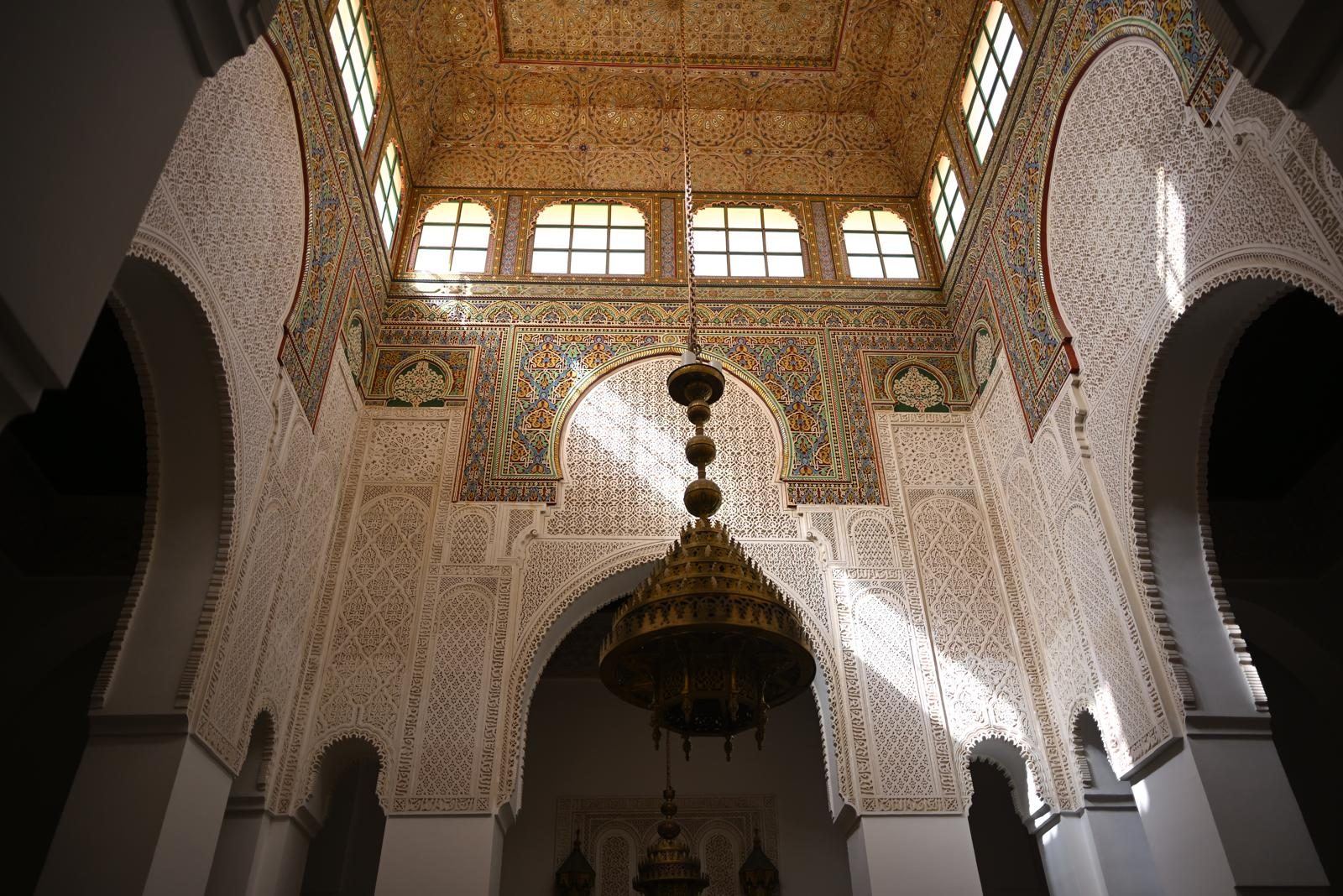
Truly understanding a language means understanding the world it comes from.
Over four weeks in Fez, you will move through six interconnected areas of study, from Arabic language and Darija to literature, translation, history, politics, and media.
What if this summer changed how you see the world?
Al-Bassira is a four-week immersion in Arabic language, Moroccan Darija, and the living culture of the MENA region, set in the ancient heart of Fez, Morocco. It brings together curious, driven students from all backgrounds and levels, not just to study the Arab world, but to experience it.
Mornings in the classroom. Afternoons in deep conversation. Evenings lost in one of the most extraordinary medinas on earth. Weekends across Morocco.
This is not a language course. This is a shift in perspective.
A small, hand-selected group of curious students from across the world.
Al-Bassira brings together a carefully selected group of students from diverse international backgrounds and academic disciplines, from complete beginners to advanced Arabic learners. Participants are chosen not just for their academic profile, but for their curiosity, openness, and genuine desire to engage with the Arab world. The result is a rich, multilingual learning environment where every voice adds something to the conversation.
Each unit is designed not just to teach you content, but to help you think more critically and engage more deeply with the Arab world and its complexities.
From complete beginners to advanced learners, everyone is supported, everyone belongs in the room.
This is serious academic work. It is also one of the most enriching things you will do.
Six units, one conversation
Arabic Language & Darija
The foundation of everything. You will work on Modern Standard Arabic grammar and syntax alongside Moroccan Darija for everyday communication. Sessions also explore the relationship between the two — how Arabic functions differently across formal and informal contexts, and what that tells us about language and identity.
Literature & Cultural Expression
From classical Arabic texts and poetry to modern and contemporary literature, this module introduces you to the richness of Arab cultural expression across time. Oral storytelling traditions are explored, giving you a sense of how stories have been passed down and transformed across generations.
Translation Studies
A practical and intellectually demanding unit. You will work on translating between Arabic and English, with French as a support language, exploring not just the mechanics of translation but the cultural nuances and choices that make it such a complex and creative act. Literary and journalistic translation are both covered.
History & Intellectual Traditions
From pre-Islamic Arabia to postcolonial states, this unit traces the long arc of Arab history and thought. You will engage with key reform movements, nationalist ideas, and the intellectual traditions that have shaped the modern Arab world.
Politics & Society
One of the most discussion-driven units of the program. Topics include colonial legacies, state formation, language politics across Arabic, Darija, Amazigh and French, and contemporary debates around gender, migration, and identity in the MENA region.
Media & Cultural Production
An exploration of how Arab culture expresses itself today, through film, music, and digital media. Special attention is given to the role of Darija in contemporary Moroccan media and how popular culture both reflects and shapes society.
Focused mornings, open afternoons, evenings in the medina.
Every day is structured to give you a good balance between focused academic work and time to breathe, explore, and connect.
Fridays run a slightly shorter morning session from 09:00 to 12:00, giving you a head start on the weekend.
Four thematic weeks, each building on the last
Language & Identity
- Alphabet & phonetics (Beginners)
- Diglossia: MSA vs Darija
- Text: proverbs + short dialogues
- Theme: What is Arab identity?
- Amazigh cultures & multiculturalism
Storytelling & Classical Heritage
- Grammar: sentence structures
- Text: Kalila wa Dimna
- Translation: simple narrative passages
- Lecture: the adab tradition
Colonialism & Memory
- Grammar: verb forms
- Text: Kanafani excerpts
- Theme: colonialism, postcolonialism, Palestine
- Text: Orientalism excerpts
- Media Arabic: news & interviews
Urban Life & Society
- Text: Mahfouz and contemporary short stories
- Darija: urban conversations
- Topic: class & city life
- Texts by Fatema Mernissi
- Debate: gender and society
- Final presentations
Every level has something substantial
One of the things that makes Al-Bassira unique is the quality and diversity of the texts we work with — from adapted folk tales for beginners to some of the most important works in modern Arabic literature for advanced learners.
Foundations
- Kalila wa Dimna (adapted excerpts)
- Al-Kitaab & introductory textbooks
- Moroccan folk tales (simplified)
The Canon Opens
- Men in the Sun — Ghassan Kanafani
- Selected poems by Mahmoud Darwish
- Short stories by Naguib Mahfouz
Into the Depths
- Season of Migration to the North — Tayeb Salih
- The Yacoubian Building — Alaa Al-Aswany
- Orientalism — Edward Said
- Works by Fatema Mernissi
Fair, flexible, adapted to your level
No stressful final exams. Instead, your progress is evaluated through ongoing participation, a midterm task, and a final project you choose based on your own interests and strengths.
Learning happens through conversation
English and French are used as support languages throughout, so no one ever feels lost. Beginners and advanced learners sit in the same sessions and learn from each other as much as from the instructor. That mix of perspectives, backgrounds, and levels is not a challenge to manage. It is one of the things that makes Al-Bassira genuinely unique.
Above all, we see ourselves as cultural mediators, helping you build bridges between your own background and the world of the MENA region, one session at a time.